

A calm, complete guide
Your AMH is a starting point, not a verdict.
AMH tells you how many eggs remain — not whether you can get pregnant, not egg quality, not IVF success. Here's what the number means, how to read it against your age, and where to go next.
If You Only Read This Much
The 4 things to take away from this guide
AMH measures egg quantity, not egg quality — it can't tell you if you'll get pregnant.
There's no universal "good" number — only what's typical for your age and goals.
A low or high result is a starting point, not a diagnosis on its own.
The clearest answer comes from reading AMH alongside your full fertility picture.
What AMH measures
It's an estimate of how many eggs remain — not their quality, and not your odds.
What AMH Actually Measures
Anti-Müllerian Hormone (AMH) is produced by the small, developing follicles in your ovaries. Because those follicles reflect the size of your remaining egg supply, the level in your blood gives a rough estimate of your ovarian reserve: how many eggs you have left, not how healthy or genetically normal they are.
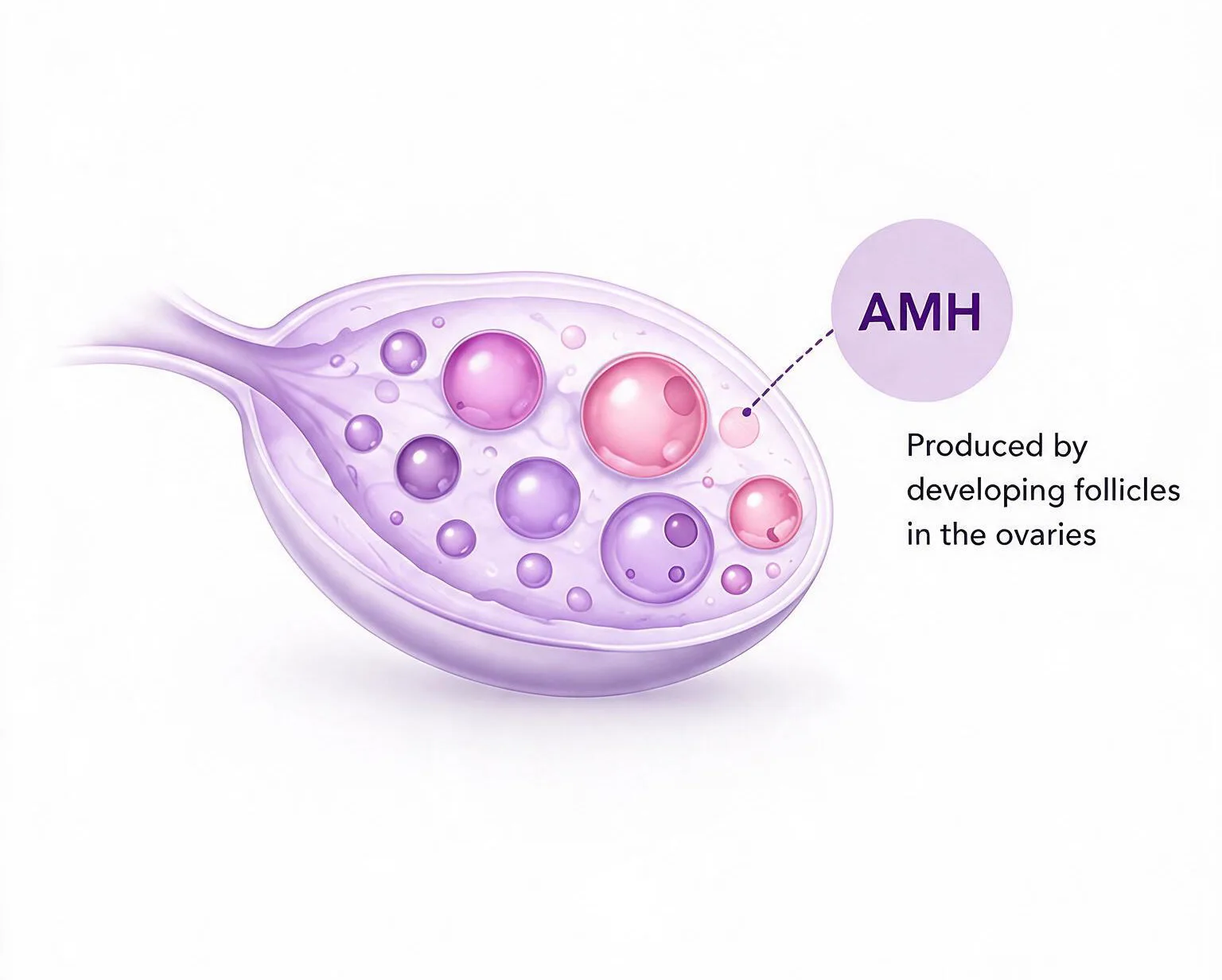
Egg Quantity
A rough estimate of your remaining egg supply and ovarian reserve.
How many eggs you have left.
Egg Quality
How healthy or genetically normal your eggs are.
Ability to Get Pregnant
Your chance of conceiving naturally or with treatment.
IVF Success
How you will respond to IVF or the chance of a successful cycle.
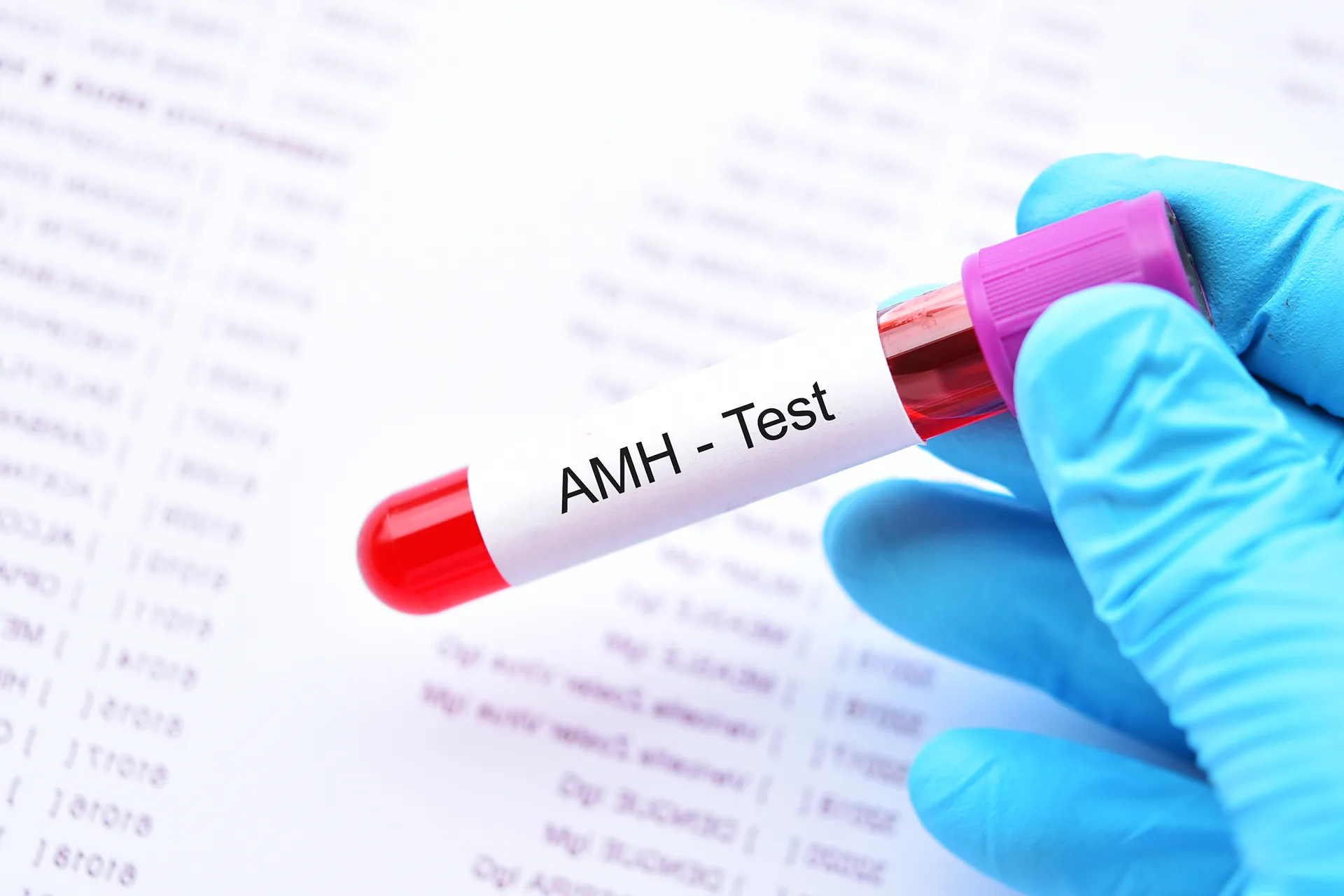
It is measured with a simple blood test and reported in ng/mL (some labs use pmol/L). Unlike many reproductive hormones, AMH stays relatively steady across the menstrual cycle, so in most cases it can be drawn on any day; one reason it appears so often on fertility panels.
The key thing to hold onto: AMH speaks to quantity, not quality. For a deeper look at what a result means and what to do next, see our pillar guide, AMH and Fertility: What It Means and What to Do Next. Most fertility clinics include AMH as part of an initial fertility workup. It can also be ordered by your OB GYN or primary care provider. There is no special preparation required. You do not need to fast, schedule the test around your menstrual cycle, or make medication changes beforehand unless your physician advises otherwise.
For many people, getting started is easier than they expect. AMH testing may be available through a local laboratory or, in some cases, ordered online so you can begin your fertility evaluation from home before meeting with a healthcare provider. Regardless of where your blood sample is collected, your results should always be reviewed and interpreted by a qualified healthcare professional as part of your fertility evaluation.
A "good" level
There's no single "good" number — only what's typical for your age.
What Is Considered a "Good" AMH Level?
There is no single number that defines a "good" result, and there is no universal cutoff that every clinic agrees on. What specialists do use are general reference ranges that sort results into broad categories.
As a rough guide for adults in their reproductive years:
The most important question is not whether your AMH is normal. It is whether your AMH is appropriate for your age, fertility goals, and fertility evaluation. A level that is perfectly workable if you are trying to conceive now may look different if your goal is egg freezing, where banking more eggs per cycle is an advantage. And heading into IVF, a higher AMH generally predicts more eggs retrieved per cycle, but there is no strict minimum, and people conceive across a very wide AMH range. "Good" is the number that fits your age, your timeline, and your plan.
Why age matters
The same number means something different at every age.
Why "Good" Depends on Your Age
AMH naturally declines as you get older, so the very same number can mean different things at different ages.
That's why a result should be read against age-specific expectations rather than one fixed line in the sand.
AMH is just one piece of the puzzle. Your overall fertility picture includes your age, antral follicle count, hormone testing, medical history, and your goals.
Here's how the same AMH result can mean something very different depending on age.
May be within the expected range for this age and may still be very workable.
Would be considered lower than typical and may prompt a closer look at your overall reproductive picture.
Neither result is "bad" on its own; they simply lead to different conversations.
One reason AMH testing can be valuable is that it may identify declining ovarian reserve before fertility challenges become apparent, allowing patients to make more informed decisions about timing, treatment, or fertility preservation.
Does a "Good" or High Number Mean You Will Get Pregnant?
AMH is only one piece of a much bigger fertility picture.
A reassuring AMH is good news about egg quantity, but it is not a guarantee of pregnancy. The number says nothing about egg quality, and it does not account for your fallopian tubes, your uterus, sperm, ovulation, or timing, all of which matter.
Plenty of people with normal or even high AMH still need help conceiving, and plenty of people with lower AMH conceive naturally or with treatment. A good number is best read as "your ovaries likely have a reasonable supply to work with," not as a green light or a finish line.

Whatever your number, the path forward starts with understanding it fully.
What If Your Number Is Lower Than You Hoped?
A low AMH points to a smaller remaining egg supply, not to infertility, and not to poor egg quality. In most cases, the number itself matters less than two things: your timing and having a clear, individualized plan.
Because low AMH deserves real depth, we cover it across several dedicated pages: What Should I Do If My AMH Is Low?, What Causes Low AMH?, and Can Low AMH Be Improved?, all of which build on the pillar guide.
What If Your Number Is High?
A high AMH, often above roughly 5 ng/mL, usually reflects a large number of small follicles. On its own, that is not a problem, but it is worth understanding what may be driving it.
- PCOS or polycystic ovarian morphology is the most common reason. A high AMH, especially alongside irregular cycles, is one of the signals that prompt evaluation for polycystic ovary syndrome.
- It can be an advantage in IVF. More follicles can mean more eggs retrieved in a cycle.
- It also changes how stimulation is dosed. A high follicle count raises the risk of overstimulation (OHSS), so medication is adjusted carefully.
One number alone
AMH is one input among several — never read in isolation.

One number rarely tells the whole story — here's what completes the picture.
Why One Number Cannot Stand Alone
AMH is one input among several. A meaningful read pairs it with the rest of the picture:
An ultrasound looks at how many follicles are visible right now.
Reserve
If you have had a cycle, this is some of the most useful information available.
Hormone levels that help assess ovarian function and hormonal signalling.
Half of the picture, and easy to overlook when focusing on AMH.
Structure as well as numbers.
The most accurate assessment comes from evaluating all factors together.
Your Fertility Journey Starts With Understanding the Complete Picture
Whether you are just beginning to think about having children, trying to conceive today, considering fertility preservation, or preparing for IVF, an AMH result is only one part of your fertility journey.
For some people, an AMH test provides reassurance. For others, it raises new questions. The most important next step is understanding what your result means in the context of your age, ovarian reserve, ultrasound findings, reproductive goals, and overall health.
A comprehensive fertility evaluation provides far more information than a single laboratory value. Understanding the complete picture early often creates more opportunities to make informed decisions, optimize reproductive health, and build a personalized plan for the future.
From the physician
Dr. Allon's Perspective

AMH is one of the most helpful tests we have for understanding ovarian reserve. But it's just one piece of a much larger puzzle.
One of the things I have learned after more than 25 years in fertility medicine is that fertility should never be defined by a single laboratory result. Too often, patients receive an AMH result and immediately begin worrying about what it means without understanding everything else that influences their fertility.
An AMH test is an important starting point, but it is only one piece of the picture. Understanding your fertility requires looking at your age, your reproductive goals, your medical history, and, when appropriate, additional testing that helps explain what your AMH result really means.
One of the most valuable tools during a comprehensive fertility evaluation is comparing the AMH blood test with the antral follicle count measured during a transvaginal ultrasound. Looking at both together often provides a much clearer understanding of ovarian reserve than either test alone and helps guide more personalized recommendations.
I also believe that preparing for pregnancy often begins before fertility treatment. Supporting overall reproductive health through nutrition, lifestyle, metabolic health, and other individualized recommendations may help create the healthiest possible environment for conception. Every person's fertility journey is different, which is why recommendations should always be personalized rather than based on a single laboratory value.
My goal is never simply to explain an AMH result. My goal is to help each patient understand their fertility more completely, identify opportunities to optimize their reproductive health, and make informed decisions about the path that is right for them.

AMH is one piece of the puzzle. Your complete fertility story matters most.
How AFCT Interprets Your AMH
At the Advanced Fertility Center of Texas, an AMH result is never viewed in isolation. It is one important piece of a comprehensive fertility evaluation designed to better understand your reproductive health, identify opportunities to optimize fertility, and develop a personalized plan based on your goals.
of your AMH alongside your age, reproductive goals, medical history, and other fertility testing.
measured during a transvaginal ultrasound when appropriate, to provide a more complete assessment of ovarian reserve.
and identifying whether additional evaluation may be helpful before developing a personalized treatment plan.
that may influence fertility, including hormone testing, uterine health, male fertility, metabolic health, and other clinical findings when appropriate.
that may include fertility treatment, fertility preservation, nutrition, lifestyle guidance, supplements, and other supportive strategies based on your individual needs.
including ovarian rejuvenation and individualized IVF treatment strategies for appropriately selected patients.
Common Questions About AMH
There is no single "good" number, because expected ranges shift downward with age. A level that is typical at 40 would be considered low at 28. Read your result against age-specific ranges; the full chart is in the pillar guide.
Yes. AMH reflects how many eggs remain, not whether you can conceive. Many women with low AMH will conceive naturally or with treatment, because the test does not reflect egg quality or the likelihood of carrying the pregnancy to term.
No. AMH measures egg quantity. Egg quality is driven mainly by age, which is why two people with the same AMH can have very different outcomes.
Yes, mostly for planning. It gives an indication of how your own ovaries may react to stimulation and helps to determine how many eggs may be able to be retrieved, which can guide protocol and expectations. It is not an IVF pass or fail exam.
It declines gradually with age, and a single reading can vary somewhat between labs or be temporarily lowered by certain factors, such as some hormonal contraceptives. One number is not your destiny; we look at this directly in Can Low AMH Be Improved?
No. An AMH result is one piece of information, not a diagnosis. Whether your result is lower or higher than expected, it should be interpreted together with your age, ultrasound findings, and other fertility testing before deciding on the next steps.
A Clear Next Step
Whatever your AMH level, the next step is understanding what it means as part of your complete fertility evaluation.
A single AMH value cannot tell you whether you can conceive, and it should never drive a treatment decision on its own.
What it can do, read alongside your age, your goals, and the rest of your testing, is help shape a clear, personalized plan.
Get a clear, personalized evaluation of your AMH based on your testing, your timeline, and your goals, with physician led care in Houston, The Woodlands, and College Station.
Patients traveling to Houston or living outside Texas can begin with telemedicine.